Errors in Testing
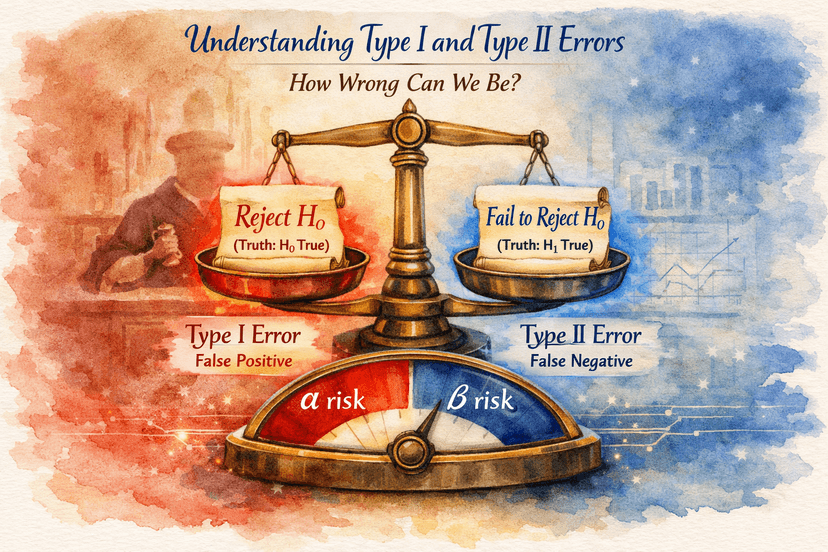
Understanding Type I and Type II Errors: How Wrong Can We Be?
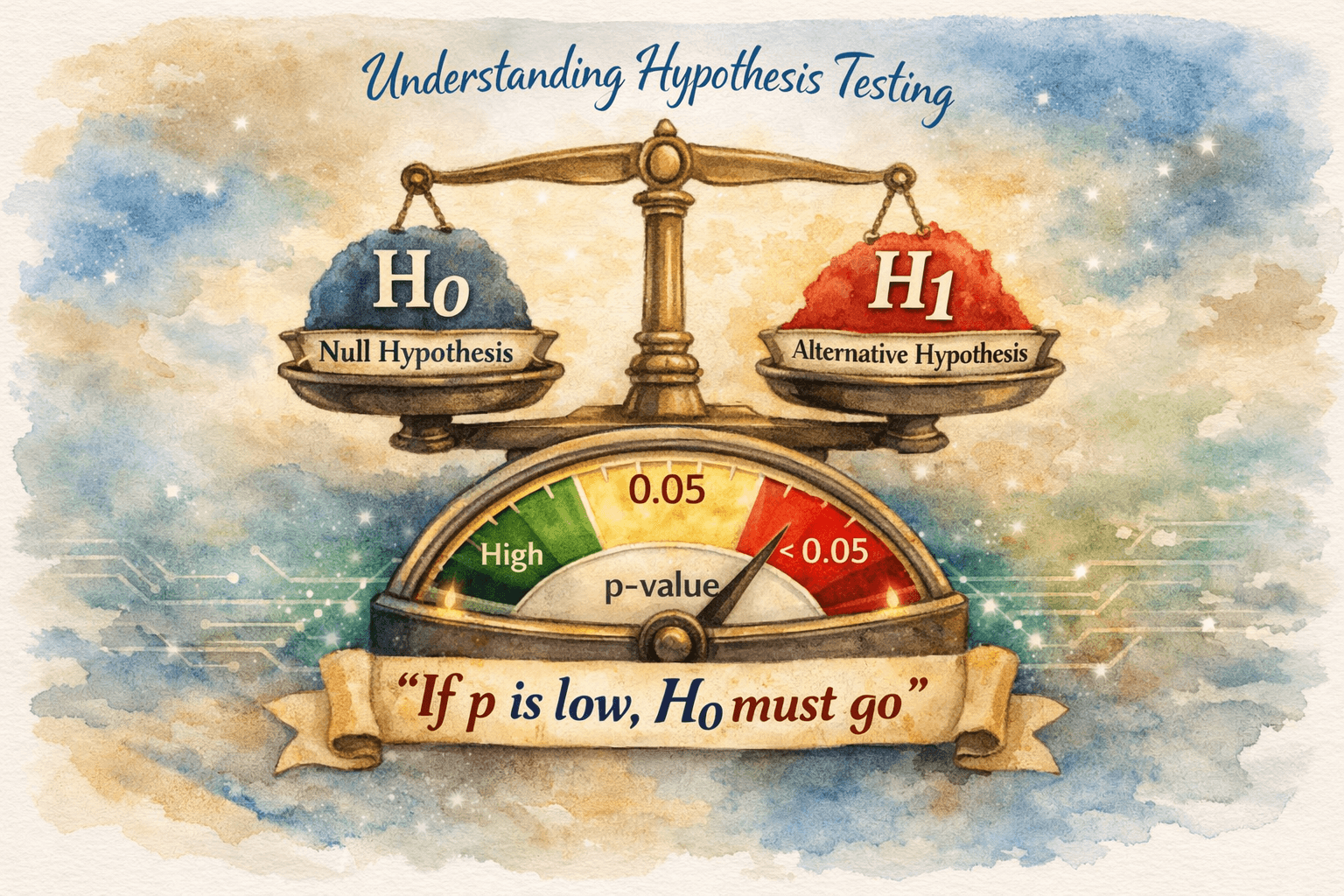
A couple of weeks ago we discussed the null hypothesis (H₀) and the alternative hypothesis (H₁). But can the acceptance or rejection of the null hypothesis be flawed? Can our statistical decision-making lead us to the wrong conclusion?
The short answer is yes - and this is where Type I and Type II errors come in.
Why Errors Occur
Statistical inference is based on samples, not full populations. Sometimes, by chance alone, a sample simply doesn't represent the underlying population well. When this happens, the sample leads us to draw conclusions that do not reflect reality - even if our calculations are correct.
To make this intuitive, we often refer to the judge analogy:
- A judge carefully examines the evidence.
- The process is rational and structured.
- And yet... the judge can still reach the wrong verdict.
In hypothesis testing, we face the same risks.
The Two Types of Errors
There are fundamentally two ways our inference can fail:
1. Rejecting the null hypothesis when it is actually true → False positive → Type I error
2. Failing to reject the null hypothesis when it is false → False negative → Type II error
These errors arise purely from random variation - not from bias. Bias introduces another class of problems (observer bias, instrument drift, recall errors, etc.), but those are not referred to as Type I or Type II errors. Bias-related errors are far more insidious because they are often invisible and difficult to quantify.
Which Error Is Worse?
It depends entirely on the context, but the thought process is universal:
- In law: Is it worse to falsely convict an innocent person (Type I) or fail to convict someone who is guilty (Type II)?
- In manufacturing: Is it worse to scrap a product that is actually good (Type I) or ship a defective product to a customer (Type II)?
- In pharmaceuticals: Is it worse to approve a drug that does nothing (Type I) or fail to approve a drug that would have helped (Type II)?
These examples illustrate an important truth:
Type II errors often have more severe consequences, yet they are harder to detect.
You can usually see a false alarm - but you rarely notice the signal you missed.
Reducing Type I and Type II Errors
Although these errors cannot be eliminated completely, we can reduce their likelihood through:
- Larger sample sizes (less random fluctuation)
- Better study design
- Higher-quality data
- Appropriate significance levels
- Clear definitions of acceptable risk
But we always face trade‑offs. Lowering the chance of a Type I error usually increases the chance of a Type II error - and vice versa. This balance must be consciously chosen based on the real-world consequences.
Statistical decisions are never made in a vacuum. Every test involves a balance between the risks of false alarms and missed signals. Understanding Type I and Type II errors is not about memorising terminology - it's about recognising the limitations of data, the consequences of decisions, and the importance of choosing an acceptable level of uncertainty.
In practice, good decision-making comes from:
- designing studies that minimise uncertainty,
- selecting sample sizes that provide meaningful power,
- and interpreting results with an understanding of what "error" really means.
When we acknowledge these risks and manage them deliberately, hypothesis testing becomes far more than a mathematical exercise - it becomes a disciplined approach to making sound, defensible decisions in an uncertain world.